Showing posts with label conservation reliance. Show all posts

Tuesday, 16 September 2014

The Dam Problem - Killing One To Let The Other Live.

Two weeks ago, I brought up the issue of "Conservation Reliance". This post is a small extension of the same topic. You may read the main post on Conservation Reliance first before going on to read this one.

As I was reading The New York Times International Weekly newspaper 3 days ago, an article caught my attention. Here's a summary of what the article reported:
When hydroelectric dams were built along the Columbia River, salmon populations plunged. Their movements along the river was hindered and restricted by the dams, and many were killed by the dam's turbines (Barringer, 2014). To revive the salmon population, habitat restoration projects were carried out, and salmon population numbers grew. However, this resulted in an increase in cormorants feeding on the salmon in the Columbia River. Many techniques were used to discourage these birds from feeding juvenile salmon, but efforts were futile. Now, the Army Corp has decided to shoot these birds dead in order to protect the salmon, and this method has stirred up a cloud of controversy.

BONNEVILLE DAM. PHOTO:  HTTP://WWW.OREGONLIVE.COM/ENVIRONMENT/INDEX.SSF/2008/07/COLUMBIA_BASIN_RIVER_MANAGERS.HTML

 These salmon are like well-pampered children. It seems like their predators more or less end up losing their lives. Since 2008, around 60 salmon-eating sea lions have been killed near the Bonneville Dam in the Columbia River (Barringer, 2014). Now, it's the cormorants' turn.

Scientists came to a consensus that current cormorant populations should be slashed by almost two-thirds in order to protect the salmon population (Barringer, 2014), and if shooting starts in 2015, up to 4000 birds will be killed each year till 2018. Already, the Army Corps has acquired permits to conduct killing of up to 150 double-crested cormorants each year at five dams along the Columbia River (Flatt, 2014),

Here's the catch. 13 of 19 salmon populations in the Columbia River have been listed either as threatened or endangered (Barringer, 2014). Thus, they can be considered as being conservation reliant, needing humans' intervention to ensure its perpetuation. On the other hand, the cormorants are not listed as endangered or threatened under the Endangered Species Act. Does that mean this act of killing the salmon-eating birds is justified? Is it fair that the building of dams by humans have upset the salmon population, and yet the birds are paying the price for it? Ironically, these birds can be considered as under human intervention, albeit to reduce their population, not conserve them.
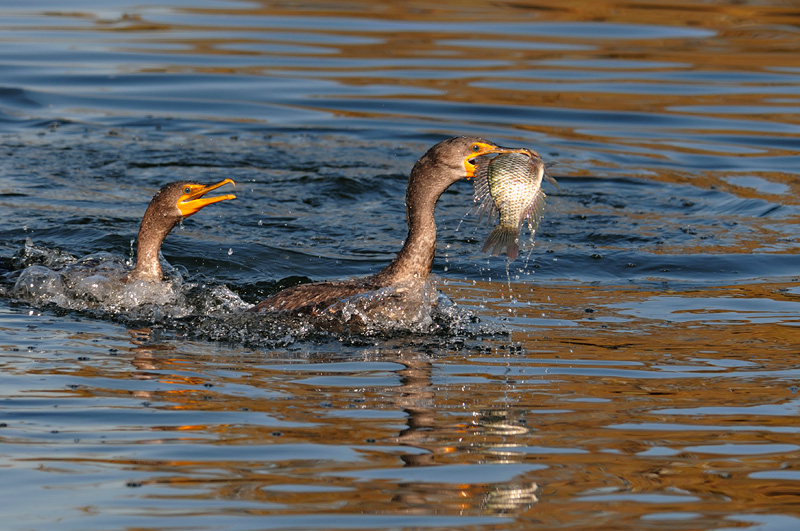
LUNCH TIME FOR THE CORMORANTS. PHOTO: HTTP://WWW.GRAHAMOWENGALLERY.COM/PHOTOGRAPHY/CORMORANTS.HTML
 My personal opinion is that killing the cormorants is too drastic a measure to be taken. While I acknowledge that ensuring the perpetuation of salmon is important, that itself is insufficient to justify the shooting of cormorants. Non-lethal methods such as avian wires,water spray cannons, pyrotechnics and noisemakers will first be used to protect the salmon and if these methods do not work, killings will start (Flatt, 2014). What I worry is that humans' attempt to intervene and protect the salmon population might backfire, and intentionally manipulating the cormorant population may end up doing more harm than good. If the killings are not carefully monitored, cormorants may even become endangered.

Certain species are conservation reliant, and warrants human intervention and protection to survive. In the case of salmon, the building of hydroelectric dams reduced salmon populations, and so it is right for us to take responsibility to protect them from extinction. I understand that the cormorants are in a way, interfering with humans' attempt to conserve the salmon population. However, it should be noted that both cormorants and salmon live in the wild, and this predator-prey relationship (birds eating the fishes) was established way back in the past. To kill the birds feels like we're interfering with nature.

Perhaps instead of focusing on how to prevent salmon from being eaten up, we can turn our attention to how we can protect salmon from death due to human activities. Engineers should take into account salmon populations when constructing dams, and design them in such a way that salmon do not get anywhere close to the turbines, or avoid the dam altogether (Thompson, 2014). Regulating the strength of water flowing, eliminating gaps between turbines that could trap fishes, having smooth surfaces in areas that may be exposed to fish contacts are just some of the ideas mooted and implemented in newly constructed dams. The authorities can consider modifying the dams along Columbia River, and hopefully, circumvent the need to kill the cormorants.

Literature Citied
Barringer, F. (2014) Taking Up Arms Where Birds Feast on Buffet of Salmon. The New York Times. [ONLINE] 15 August. Available at: http://www.nytimes.com/2014/08/16/us/taking-up-arms-where-birds-feast-on-buffet-of-salmon.html?_r=0. [Accessed 13 September 14].
Flatt, C. (2014) Fish-Eating Birds To Be Killed At 5 Dams. OPB. [ONLINE] 27 March. Available at: http://earthfix.opb.org/flora-and-fauna/article/5-dams-to-kill-nuisance-birds-to-protect/. [Accessed 13 September 14].
Thompson, E. (2014) Engineering a More Fish-Friendly Dam. Illumin. [ONLINE] Available at:
 http://illumin.usc.edu/printer/29/engineering-a-more-fish-friendly-dam/. [Accessed 13 September 14].

Tuesday, 2 September 2014

Conservation Reliance

Q: Should Human Beings feed threatened or endangered animals?

What is your response?
--------------------------------------------------------------------------------------------------------------
I was reading about the Endangered Species Act (ESA) signed in 1973 and commissioned by The United States of America (USA). Let me condense the gist of it in layman terms:
1. Species at risk of extinction are listed under the act.
2. Risks and causes are identified.
3. Measures and response plans are implemented.
4. Species benefits and increase in numbers.
5. The species is then removed from the list.

To me, it sounds really simplistic and naive. Is saving a species really as easy as dishing out response plans and then expect a certain improvement? It was time to do a little research on Conservation Reliance, and I read an interesting Journal Article. You can read it here.

J. Michael Scott, a government biologist, lamented that "a fundamental belief behind so much conservation - that we can "save" a species by solving a particular problem it faces, then walk away and watch it thrive - is largely delusional." Indeed, I agree with this statement, but hold views and ideas slightly different from him about efficiency of conservation reliance.

A polar bear and her cubs in Alaska
A POLAR BEAR AND HER CUBS IN ALASKA. PHOTO: AP
Generally, a species is conservation reliant when the threat if faces cannot be eliminated but only managed.(Goble et al., 2012, p.869). In his Journal Article, it was stated that 84% of the species listed under the Act are conservation reliant (Scott et al., 2010, p.91). In my opinion, all species listed should be considered as conservation reliant. After all, not intervening, whether active or passive, seemingly defeats the purpose of including the species on the list.

However, what I liked about the Journal Article was that Scott published a comprehensive and detailed study about methods of conservation reliance programmes such as "Control of other species, Active habitat management, Control of direct human impacts etc." Indeed, the ecosystem is interlinked, and ensuring the perpetuation of one species would mean dealing with environmentally-detrimental human actions, monitoring and regulating the population of other species, and adopting good management systems for the environment.


CALIFORNIAN CONDOR. PHOTO: FWS.GOV
Examples of high human intervention includes the Guam kingfisher, (Todiramphus cinnamominus) which is now found only in captivity (Goble et al., 2012, p.870) under a breeding program. It is thus, considered extinct from the wild, primarily because of the brown tree snake, a non-native, invasive species introduced by Human Beings, either deliberately or by accident, that nearly wiped out the Guam kingfisher. Another species, the California Condor (Gymnogyps californinus) (photo above) is reared in captivity and repeatedly released into the wild. (Goble et al., 2012, p.870)

This concept of conservation reliance may seem like a good idea in protecting species from possible extinction, but then this means that the majority of endangered species are only surviving if Human Beings intervene and are actively engaged and involved in shaping the world and the environment to suit their needs.This strain resources, is expensive, and even pose a danger to these animals if we ever stop intervening. An analogy would be releasing a domesticated animal into the wild after years of captivity. What are the chances the animal would know how to protect and defend itself, or even built up a strong survival instinct? By then, the animal would have probably been eaten up by its predator.  It is like "Playing God", cultivating the species we desire, deciding where to place them, what to feed them, and how to safekeep them. It is also indirectly and discreetly admitting that their ecosystem is irreparable (Mooallem, 2013), that we are responsible for the damage (which is kind of true), and obliged to save them continuously to ensure their survival.

 The list of species on the ESA is ever increasing. Will we be able to handle them all? Is this a sustainable way of protecting the species from extinction? How much human intervention should be involved? What happens if we stop providing for them?

Ultimately, while I question the pragmatism of such approach, I admit that this practice is crucial to ensure sustainability of biodiversity and wildlife. The best method would be tackling poaching, global warming, climate change, deforestation - and the list of environmental problems goes on...This is a tall order and so unfortunately or fortunately, (depending on how you view conservation reliance) looking at the current situation, this method may be the best for now.

Remember the question I posed at the very beginning of this post? Have you change your mind, or is your response still the same?

 Literature Citied

Dale D. Goble, John A. Wiens, J. Michael Scott, Timothy D. Male, and John A. hall. (2012) Conservation-Reliant Species. Oxford Journals. [Online]. Vol. 62 (10). p.869 - 873. Available at: http://bioscience.oxfordjournals.org/content/62/10/869.full.pdf [Accessed 01 September 2014].
J. Michael Scott, Dale D.Goble, Aaron M. Haines, John A. Wiens, and Maile C. Neel (2010) Policy Perspective - Conservation-reliant species and the future of conservation. Wiley Periodicals, Inc. [Online]. Conservation letters 3 (1). p.91 - 97. Available at: http://www.webpages.uidaho.edu/css235/Scott_et_al2010.pdf [Accessed 01 September 2014].
Mooallem, J. (2013) Wild Ones: A Sometimes Dismaying, Weirdly Reassuring Story about Looking at People Looking at Animals in America. New York: Penguin, Print.