Tuesday, 23 September 2014

Environmental Generational Amnesia

Yes, the title is pretty complicated. No I didn't make that up.
 This term was popularised by psychologist Peter H. Kahn Jr in one of his scholarly articles. You may read the online version of it (best I could find) here.

Basically, he worries that future generations may be unaware of the situations before they were born, and gauge the extent of current environmental impacts base on what they have experienced or witness from childhood. As each generation pass, we inherit a standard set by the previous generation, and gauge the severity of changes against the norms. Here's a fictional example:
How many lions does it take to ..., East African Safaris, Tanzania
LIONS. PHOTO: CRAGDORIASAFARIS.COM
 In 1970, There were originally 30 lions living in a jungle. Due to loss of habitat, number of lions fell to 10 after 20 years (1990). Their population continues to fall till none is left in 2014.

Lets say that you were a teenager in 1990, when the lion population was 10. If someone asks you how many lions were wiped out to the point that there's none in 2014, your answer would be a "10", simply because you used the 1990's statistic(10) as a baseline. You were unaware that back in 1970 (when you were'nt even born yet), number of lions was originally at 30. And so, number of lions wiped out should be 30, not 10.

Notice how from that example, you can tell that there is a tendency to understate the extent of changes depending on where the baseline is fixed at. This problem stems from the term "Shifting baseline syndrome", which I wouldn't be talking about in detail lest there's an information overload. Basically, every scientist accepts the data as they inherit them. These scientists are unaware of how much has changed, and instead, use the already declining situation as the baseline, and then during their careers, record even further declines (Mooallem, 2013). This continues and declining rates gets even worse.

Now here's a real example extracted from the book "Wild Ones" by Jon Mooallem.

Bald Eagle Photo
BALD EAGLE. PHOTO: RAYMOND LEE, ALLABOUTBIRDS.ORG
In 1973, number of bald eagles in America numbered around 417 nesting pairs.
In 2007, the effort to increase their population size was considered a success and it was removed from the Endangered Species Act, as numbers rose to 10, 000 nesting pairs.
But...
Much further back in 1782, there were an estimated of 50, 000 nesting pairs.
So here's the question.
Do we count the 10, 000 nesting pairs as a mega achievement or just a slight improvement to the declining figures? Unfortunately, if you base it against the statistics of 1782, it is still a population decline, and there isn't really anything much to celebrate.

Are we underestimating the rate of decline? Where should we set the baseline in order to agree on a reliable and accurate statistical value?

 As mentioned by Milner-Gullanddid (2009), one of the authors for a research paper on shifting baseline syndrome, there are ways to circumvent this problem, such as getting the older generation to narrate personal recounts to the younger generations about how the environment was years ago and how much it has changed, or providing hard evidence such as photos or old samples to prove the extent of impact.

Ultimately, this problem may have implications on our efforts in environmental conservation. People forget what the past look like, and the current state becomes the new baseline. With "Shifting Baseline Syndrome" and "Environmental Generational Amnesia", it may be hard to convince members of the public-especially the younger generations, the severity and extent of the decline in animal populations over time. There may be misconceptions, as people fix their baselines during their time period and perceive the extent of changes to be minimal, becoming cynical when environmentalist stressed the vast decline in numbers. This problem is exacerbated when there are no or insufficient data about the conditions of the ecosystem in the past ( Hance, 2009) to validate the severity of the problem.

This term is still in its infancy, and more research is currently on-going to analyse how "Environmental Generational Amnesia" could affect conservation efforts. What I worry is that if we start out with an already depressingly low baseline, we would barely react with shock and just be ambivalent if it shifts further.

Literature Citied

Hance, J. (2009) Proving the ‘shifting baselines’ theory: how humans consistently misperceive nature. [ONLINE] Available at: http://news.mongabay.com/2009/0623-hance_shiftingbaselines.html. [Accessed 15 September 2014].
Kahn, P. H. Jr. (2002) “Children’s Affiliations with Nature: Structure, Development, and the Problem of Environmental Generational Amnesia.” - Children and Nature. Massachusetts: Massachusetts Institute of Technology.
Mooallem, J. (2013) Wild Ones: A Sometimes Dismaying, Weirdly Reassuring Story about Looking at People Looking at Animals in America. New York: Penguin, Print.
 S.K. Papworth, J. Rist, L. Coad, & E.J. Milner-Gulland. (2009) Evidence for shifting baseline syndrome in conservation. Conservation Letters 2, pg. 93–100.

Tuesday, 16 September 2014

The Dam Problem - Killing One To Let The Other Live.

Two weeks ago, I brought up the issue of "Conservation Reliance". This post is a small extension of the same topic. You may read the main post on Conservation Reliance first before going on to read this one.

As I was reading The New York Times International Weekly newspaper 3 days ago, an article caught my attention. Here's a summary of what the article reported:
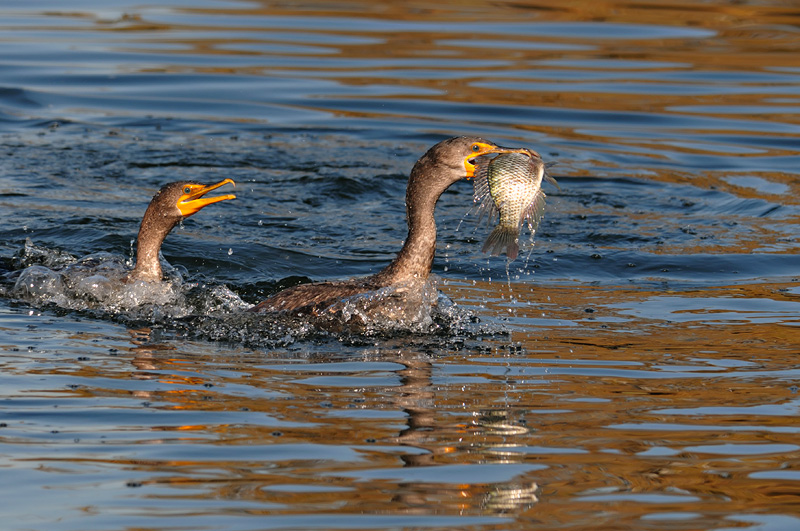
When hydroelectric dams were built along the Columbia River, salmon populations plunged. Their movements along the river was hindered and restricted by the dams, and many were killed by the dam's turbines (Barringer, 2014). To revive the salmon population, habitat restoration projects were carried out, and salmon population numbers grew. However, this resulted in an increase in cormorants feeding on the salmon in the Columbia River. Many techniques were used to discourage these birds from feeding juvenile salmon, but efforts were futile. Now, the Army Corp has decided to shoot these birds dead in order to protect the salmon, and this method has stirred up a cloud of controversy.

BONNEVILLE DAM. PHOTO:  HTTP://WWW.OREGONLIVE.COM/ENVIRONMENT/INDEX.SSF/2008/07/COLUMBIA_BASIN_RIVER_MANAGERS.HTML

 These salmon are like well-pampered children. It seems like their predators more or less end up losing their lives. Since 2008, around 60 salmon-eating sea lions have been killed near the Bonneville Dam in the Columbia River (Barringer, 2014). Now, it's the cormorants' turn.

Scientists came to a consensus that current cormorant populations should be slashed by almost two-thirds in order to protect the salmon population (Barringer, 2014), and if shooting starts in 2015, up to 4000 birds will be killed each year till 2018. Already, the Army Corps has acquired permits to conduct killing of up to 150 double-crested cormorants each year at five dams along the Columbia River (Flatt, 2014),

Here's the catch. 13 of 19 salmon populations in the Columbia River have been listed either as threatened or endangered (Barringer, 2014). Thus, they can be considered as being conservation reliant, needing humans' intervention to ensure its perpetuation. On the other hand, the cormorants are not listed as endangered or threatened under the Endangered Species Act. Does that mean this act of killing the salmon-eating birds is justified? Is it fair that the building of dams by humans have upset the salmon population, and yet the birds are paying the price for it? Ironically, these birds can be considered as under human intervention, albeit to reduce their population, not conserve them.

LUNCH TIME FOR THE CORMORANTS. PHOTO: HTTP://WWW.GRAHAMOWENGALLERY.COM/PHOTOGRAPHY/CORMORANTS.HTML
 My personal opinion is that killing the cormorants is too drastic a measure to be taken. While I acknowledge that ensuring the perpetuation of salmon is important, that itself is insufficient to justify the shooting of cormorants. Non-lethal methods such as avian wires,water spray cannons, pyrotechnics and noisemakers will first be used to protect the salmon and if these methods do not work, killings will start (Flatt, 2014). What I worry is that humans' attempt to intervene and protect the salmon population might backfire, and intentionally manipulating the cormorant population may end up doing more harm than good. If the killings are not carefully monitored, cormorants may even become endangered.

Certain species are conservation reliant, and warrants human intervention and protection to survive. In the case of salmon, the building of hydroelectric dams reduced salmon populations, and so it is right for us to take responsibility to protect them from extinction. I understand that the cormorants are in a way, interfering with humans' attempt to conserve the salmon population. However, it should be noted that both cormorants and salmon live in the wild, and this predator-prey relationship (birds eating the fishes) was established way back in the past. To kill the birds feels like we're interfering with nature.

Perhaps instead of focusing on how to prevent salmon from being eaten up, we can turn our attention to how we can protect salmon from death due to human activities. Engineers should take into account salmon populations when constructing dams, and design them in such a way that salmon do not get anywhere close to the turbines, or avoid the dam altogether (Thompson, 2014). Regulating the strength of water flowing, eliminating gaps between turbines that could trap fishes, having smooth surfaces in areas that may be exposed to fish contacts are just some of the ideas mooted and implemented in newly constructed dams. The authorities can consider modifying the dams along Columbia River, and hopefully, circumvent the need to kill the cormorants.

Literature Citied
Barringer, F. (2014) Taking Up Arms Where Birds Feast on Buffet of Salmon. The New York Times. [ONLINE] 15 August. Available at: http://www.nytimes.com/2014/08/16/us/taking-up-arms-where-birds-feast-on-buffet-of-salmon.html?_r=0. [Accessed 13 September 14].
Flatt, C. (2014) Fish-Eating Birds To Be Killed At 5 Dams. OPB. [ONLINE] 27 March. Available at: http://earthfix.opb.org/flora-and-fauna/article/5-dams-to-kill-nuisance-birds-to-protect/. [Accessed 13 September 14].
Thompson, E. (2014) Engineering a More Fish-Friendly Dam. Illumin. [ONLINE] Available at:
 http://illumin.usc.edu/printer/29/engineering-a-more-fish-friendly-dam/. [Accessed 13 September 14].

Tuesday, 9 September 2014

Sustainable Seafood

The past few posts have been pretty pessimistic, but here is one that will probably cheer you up a little: There has been greater emphasis on sustainable seafood in this year! (Score one for the marine creatures!) In this post, I'll be focusing on the progress of the local scene here in Singapore.
 Ask a Singaporean what sort of seafood he or she loves, chances are delicacies such as "Chilli Crab" and "Lobster Rolls" top the list. Unfortunately, "Shark's Fins" is also one of the more commonly eaten delicacies not just in Singapore, but over most parts of Asia. More often than not, the way these sharks are caught for their fins are not only inhumane (most sharks are still alive as their fins are sliced off), but greatly threatens the propagation of many shark species. The poster below illustrates that 90% of the world's shark population has been killed in just 10 years. This is worrying indeed.

STATISTICS OF SHARK-FINNING PRACTICES. PHOTO: TRAVEL.TRUELIFE.COM
Again, another diagram illustrating the vast markets and trading involved for shark's fins in 2008. You may have also noticed that Singapore exported the second-highest amount of shark's fins (1,201,236 kg worth of dried and frozen fins) to Hong Kong.

http://www.speakupforblue.com/wordpress/wp-content/uploads/2013/01/shark-catch-distribution.png
COUNTRIES EXPORTING SHARK'S FINS TO HONG KONG. PHOTO: SPEAKUPFORBLUE.COM
However, this is changing. 8 June 2014 to 15 June 2014 was an important period for Singapore in the sustainable seafood scene, as it kick-started Singapore's first WWF Sustainable Seafood Festival 2014. It was a good step forward in raising awareness to highlight the plight of marine organisms, educating fisheries, seafood restaurants and consumers.   Here's the video by WWF on the reasons why they decided to carry out such a Festival:


Progress didn't stop there. Singapore Airlines (SIA) cargo also announced that they would stop carrying shark's fins from August 2014, joining the likes of other airlines such as Cathay Pacific, Qantas and Air New Zealand (Tan, 2014). This is a big step and victory for wildlife protection groups, amid raised concerns about the unethical and inhumane practice of shark-finning. The arrival of integrated resorts like Resorts World Sentosa and Marina Bay Sands have also boosted local demand for sustainable seafood, resulting in many companies including Small Medium Enterprises (SMEs) venturing into this area. These companies are making profits and generating revenue (Mok, 2014), a testimony to increased demand for sustainable seafood in Singapore.

 As a start, consumers may look out for these eco-labels certified on sustainably-sourced seafood (as seen below), which are awarded by the Marine Stewardship Council, the world's leading certification and eco-labelling programme for sustainable seafood.

http://www.msc.org/multimedia/images/where-to-buy-images/msc-ecolabel/image_preview
MARINE STEWARDSHIP COUNCIL ECOLABEL PHOTO: MSC.ORG
The choice lies in our hands. To safeguard the future of marine wildlife and protect the seafood resources of future generations, the onus is on us to practice sustainable seafood methods for fisheries, and for consumers, choose the seafood we eat wisely, and only from sustainable sources

Literature Citied


Mok F. F. (2014) Sustainable seafood is no fishy business. [ONLINE] Available at: http://www.stjobs.sg/career-resources/workplace-success/sustainable-seafood-is-no-fishy-business/a/171681. [Accessed 07 September 2014].
Tan S. W. (2014) SIA Cargo to stop carrying shark’s fins from August. [ONLINE] Available at: http://www.channelnewsasia.com/news/singapore/sia-cargo-to-stop/1225450.html. [Accessed 07 September 2014].

Tuesday, 2 September 2014

Conservation Reliance

Q: Should Human Beings feed threatened or endangered animals?

What is your response?
--------------------------------------------------------------------------------------------------------------
I was reading about the Endangered Species Act (ESA) signed in 1973 and commissioned by The United States of America (USA). Let me condense the gist of it in layman terms:
1. Species at risk of extinction are listed under the act.
2. Risks and causes are identified.
3. Measures and response plans are implemented.
4. Species benefits and increase in numbers.
5. The species is then removed from the list.

To me, it sounds really simplistic and naive. Is saving a species really as easy as dishing out response plans and then expect a certain improvement? It was time to do a little research on Conservation Reliance, and I read an interesting Journal Article. You can read it here.

J. Michael Scott, a government biologist, lamented that "a fundamental belief behind so much conservation - that we can "save" a species by solving a particular problem it faces, then walk away and watch it thrive - is largely delusional." Indeed, I agree with this statement, but hold views and ideas slightly different from him about efficiency of conservation reliance.

A polar bear and her cubs in Alaska
A POLAR BEAR AND HER CUBS IN ALASKA. PHOTO: AP
Generally, a species is conservation reliant when the threat if faces cannot be eliminated but only managed.(Goble et al., 2012, p.869). In his Journal Article, it was stated that 84% of the species listed under the Act are conservation reliant (Scott et al., 2010, p.91). In my opinion, all species listed should be considered as conservation reliant. After all, not intervening, whether active or passive, seemingly defeats the purpose of including the species on the list.

However, what I liked about the Journal Article was that Scott published a comprehensive and detailed study about methods of conservation reliance programmes such as "Control of other species, Active habitat management, Control of direct human impacts etc." Indeed, the ecosystem is interlinked, and ensuring the perpetuation of one species would mean dealing with environmentally-detrimental human actions, monitoring and regulating the population of other species, and adopting good management systems for the environment.


CALIFORNIAN CONDOR. PHOTO: FWS.GOV
Examples of high human intervention includes the Guam kingfisher, (Todiramphus cinnamominus) which is now found only in captivity (Goble et al., 2012, p.870) under a breeding program. It is thus, considered extinct from the wild, primarily because of the brown tree snake, a non-native, invasive species introduced by Human Beings, either deliberately or by accident, that nearly wiped out the Guam kingfisher. Another species, the California Condor (Gymnogyps californinus) (photo above) is reared in captivity and repeatedly released into the wild. (Goble et al., 2012, p.870)

This concept of conservation reliance may seem like a good idea in protecting species from possible extinction, but then this means that the majority of endangered species are only surviving if Human Beings intervene and are actively engaged and involved in shaping the world and the environment to suit their needs.This strain resources, is expensive, and even pose a danger to these animals if we ever stop intervening. An analogy would be releasing a domesticated animal into the wild after years of captivity. What are the chances the animal would know how to protect and defend itself, or even built up a strong survival instinct? By then, the animal would have probably been eaten up by its predator.  It is like "Playing God", cultivating the species we desire, deciding where to place them, what to feed them, and how to safekeep them. It is also indirectly and discreetly admitting that their ecosystem is irreparable (Mooallem, 2013), that we are responsible for the damage (which is kind of true), and obliged to save them continuously to ensure their survival.

 The list of species on the ESA is ever increasing. Will we be able to handle them all? Is this a sustainable way of protecting the species from extinction? How much human intervention should be involved? What happens if we stop providing for them?

Ultimately, while I question the pragmatism of such approach, I admit that this practice is crucial to ensure sustainability of biodiversity and wildlife. The best method would be tackling poaching, global warming, climate change, deforestation - and the list of environmental problems goes on...This is a tall order and so unfortunately or fortunately, (depending on how you view conservation reliance) looking at the current situation, this method may be the best for now.

Remember the question I posed at the very beginning of this post? Have you change your mind, or is your response still the same?

 Literature Citied

Dale D. Goble, John A. Wiens, J. Michael Scott, Timothy D. Male, and John A. hall. (2012) Conservation-Reliant Species. Oxford Journals. [Online]. Vol. 62 (10). p.869 - 873. Available at: http://bioscience.oxfordjournals.org/content/62/10/869.full.pdf [Accessed 01 September 2014].
J. Michael Scott, Dale D.Goble, Aaron M. Haines, John A. Wiens, and Maile C. Neel (2010) Policy Perspective - Conservation-reliant species and the future of conservation. Wiley Periodicals, Inc. [Online]. Conservation letters 3 (1). p.91 - 97. Available at: http://www.webpages.uidaho.edu/css235/Scott_et_al2010.pdf [Accessed 01 September 2014].
Mooallem, J. (2013) Wild Ones: A Sometimes Dismaying, Weirdly Reassuring Story about Looking at People Looking at Animals in America. New York: Penguin, Print.


Tuesday, 26 August 2014

An unBEARable problem

Last week, I highlighted the problem of elephant poaching. A week later, a newspaper article in The Straits Times (22/8/14) caught my attention. It read "S'pore on key trade route for bear bile". This is something close to home, and the article reported that Singapore is involved in a long-running illegal trade in bear bile products.You may read the article here.

What is the current situation?
A BEAR AT A FARM OWNED BY GUIZHENTANG PHARMACEUTICAL, WHICH MAKES TONICS FROM BEAR BILE. PHOTO: MU CHEN/EUROPEAN PRESSPHOTO AGENCY
Overall in Asia, sun bears and moon bears are the primary targets of the TCM bear bile market (Good, 2014). Currently, domestic trade of bear bile is legal under strict regulation within mainland China and Japan but is illegal in Cambodia, Malaysia, Myanmar, Singapore, Thailand and Vietnam. However, international trade is strictly prohibited (Traffic, 2011). Unfortunately, lax regulations and poor enforcement has allowed illegal wildlife trade of bear products to occur. Bear bile products were available at 50% or more of traditional medicine outlets in China, Hong Kong, Malaysia, Myanmar and Vietnam (Traffic, 2011). Our country Singapore accounts for only 3 percent of seizures over a span of 2 years in a study of 17 Asian countries, but the local cases have been occuring routinely, suggesting the presence of a well-established and sustainable trade here (Ee, 2014).


Endangered black bear inside cage at bile farm in Weihai, China
ENDANGERED BLACK BEAR INSIDE CAGE AT BILE FARM IN WEIHAI, CHINA. PHOTO: INTERNATIONAL BUSINESS TIMES


Why and how is bear bile traded?
Bear bile is prized in traditional Chinese medicine, and harvested from caged live bears through tubes inserted into their gall bladders, which involves various painful and invasive techniques that can lead to infections. It is sold in various forms such as raw bile, whole gall bladders, pills, powder, flakes and ointments (Foley et al., 2011). These techniques continue to be put into practice despite the availability of numerous effective, affordable herbal and synthetic substitutes (Animals Asia, 2014). About 10,000 bears are kept in bile farms in China, often in cages far too small, with many decrying it as cruel (Huang, 2014).

Potential problems
Bile often contains foreign bodies such as ulcers and contaminants such as urine and faeces, especially from diseased and dying bears (Ngo, 2014). This is a huge worry on public health and welfare, as it may encourage the spread of diseases. Public education should be carried out to warn others of the risks involved.

What is being done?
In Singapore, the Agri-Food and Veterinary Authority (AVA) regularly conducts random and surprise check on shops, monitors online sources for illegal wildlife products, and constantly disseminate advisories to raise awareness and educate retailers on CITES requirements (Ee, 2014).

China's largest manufacturer of bear bile, Kai Bao Pharmaceuticals - which accounts for half of the 30 tonnes of bear bile produced in China annually - will receive state subsidies to conduct research and clinical testing of new methods and find synthetic alternatives such as poultry bile and biotransformation technology (Ngo, 2014).

My thoughts
Similar to the problem of poaching, illegal bear bile trade has to be effectively tackled.
1. It is heartening to note that bear sanctuaries have been built in many countries like China and Vietnam as a rehabilitation center for rescued bears. Perhaps more can be built in places like Russia and Laos, where illegal trade of bear bile is rampant.
2. Public campaigns should be carried out more frequently. One such campaign already in place is the "Healing without Harm" campaign involving AnimalsAsia, traditional medicine practitioners, and pharmacists. By encouraging them to dispense alternative medicine to patients, demand for bear bile can be reduced.
3. NGO's, activists and animal rights groups can come together and lobby against illegal trading of bear bile. Perhaps these groups can even have a round-table discussion with governments and policy-makers to deal with these issues. There will be a higher chance of positive results if interactions between various organisations and the government are involved. Perhaps even the masses can be engaged and be involved in discussing various ways to stop illegal trade, or even suggest plausible alternatives to discourage bear bile trafficking.

Remember, bears experience pain and trauma no different from humans.

Literature Cited

Anissa Haddadi. (2012) China: Online Outcry Over IPO Plans for Bear Bile Company. [ONLINE] Available at: http://www.ibtimes.co.uk/china-bear-bile-maker-ipo-plans-provoke-300325. [Accessed 24 August 2014].
David Ee. (2014) S'pore on 'key trade route for bear bile. [ONLINE] Available at: http://news.asiaone.com/news/singapore/spore-key-trade-route-bear-bile. [Accessed 24 August 2014].
Foley, K.E., Stengel, C.J. and Shepherd, C.R. (2011) Pills, Powders, Vials and Flakes: the bear bile trade in Asia. TRAFFIC Southeast Asia, Petaling Jaya, Selangor, Malaysia.
Kate Good. (2014) Could this breakthrough be the end to bear bile farms? [ONLINE] Available at: http://www.onegreenplanet.org/news/could-this-breakthrough-be-the-end-to-bear-bile-farms/. [Accessed 24 August 2014].
Jennifer Ngo. (2014) Biggest Chinese producer of bear bile seeks synthetic alternative. [ONLINE] Available at: http://www.scmp.com/news/china/article/1563054/biggest-chinese-producer-bear-bile-seeks-synthetic-alternative. [Accessed 24 August 2014].
Traffic. (2011) Illegal bear bile trade rampant in Asia. [ONLINE] Available at: http://www.traffic.org/home/2011/5/11/illegal-bear-bile-trade-rampant-in-asia.html. [Accessed 24 August 2014].